

By Nithin Kamath
Is the mandatory 2% CSR (Corporate social responsibility) spend for companies really necessary, and is it the best way to create social impact?
At Zerodha, we’ve allocated ~10% of our profits towards what we call “investing for the future,” mostly through the Rainmatter Foundation. The keyword for me is investing.
The problem with mandatory CSR is that I don’t think most businesses really have the bandwidth or expertise to figure out what can create the most impact.
The easiest thing is to pick projects in the regions where they operate, and the CSR rules even encourage this. This is probably one reason why a lot of CSR spending is concentrated in Maharashtra, Gujarat, and Delhi, while places/states that arguably need it more get much less.
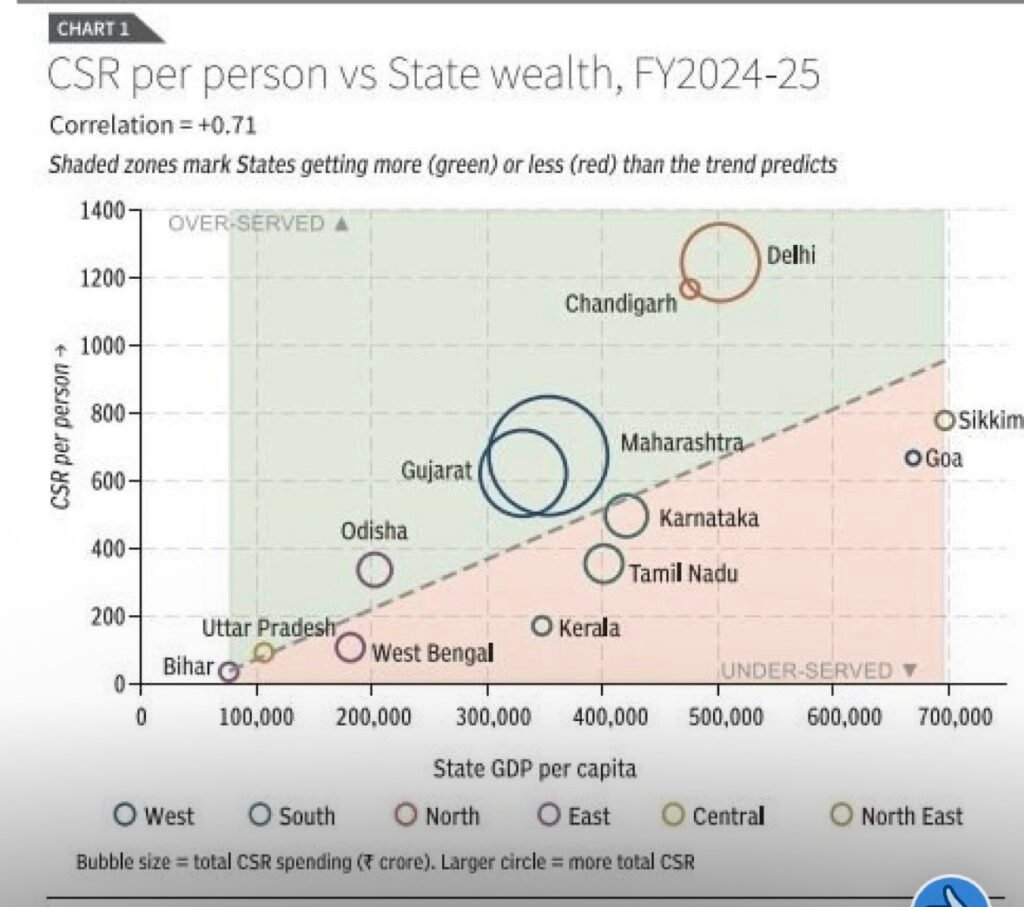
Then there is the problem of what the money is spent on. Businesses often have a bias towards the short term, but societal problems need long-term thinking.
For example, planting X lakh trees makes for a great CSR target. But what matters is whether the species planted are native and whether those trees survive for, say, 10 years. Similarly, building a school is easy to measure. But the real outcome isn’t the number of classrooms built, but whether children are actually learning.
When you tell businesses to spend X%, you run the risk of incentivising CSR spending to optimise for the wrong things. There’s also governance and leakage. The more the goal becomes deploying a budget rather than solving a problem, the greater the risk of money being wasted or misused.
I don’t know what the right solution is.
Maybe instead of a 2% CSR mandate, corporate tax could be 27% instead of 25%. The government then allocates that money wherever it can do the most good. In theory, this could spread resources more evenly across the country rather than concentrating them wherever profitable companies happen to be.
Of course, the obvious question is: would the government allocate it any better? 😬
There is another unintended consequence of the 2% number that I find interesting: anchoring.
Once you tell companies that CSR is 2% of profits, 2% can easily become the target rather than the minimum. When times are good, businesses hit 2%. When times are bad, spending naturally falls along with profits. So companies that might otherwise have chosen to spend 5%, 10%, or more may simply anchor themselves to 2%.
Maybe the real question shouldn’t be how much companies spend on CSR. It should be how much long-term impact the money creates.
Spending for the sake of spending and investing for the future are two very different things.
(The author originally published this post on LinkedIn)